Story
03 December 2025
Advancing Responsible Business: ESG & Corporate Sustainability Training Boosts Rwanda's Collective Journey Toward a Sustainable Future.
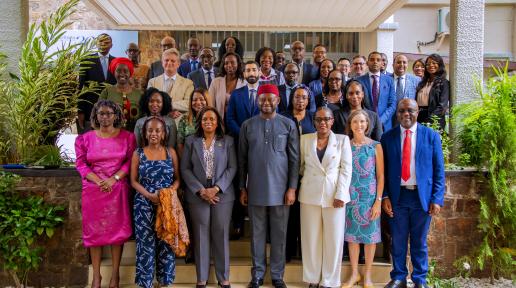
The journey of Rwanda toward sustainable, inclusive and resilient growth continues to accelerate, with the private sector taking center stage. As global markets increasingly embrace responsible business practices, Environmental, Social and Governance standards have become a defining marker of competitiveness, trust and long-term value creation. Rwandan businesses therefore face an urgent imperative to strengthen their sustainability practices and align with emerging global frameworks and standards.To further support this movement, the UN Global Compact brought together business leaders in Rwanda for a full-day ESG & Corporate Sustainability Training, equipping companies with practical means of embedding ESG principles into strategies and operations. The training reaffirmed a powerful truth: sustainability is more than a requirement—it is a collective responsibility.Embed ESG for People-Centered, Planet-Friendly GrowthInterest in sustainability and responsible business conduct is growing fast, with 30 Rwandan organizations already part of the UN Global Compact Network. Anchored in Rwanda's Vision 2050 and the green growth agenda, the training guided participants through concrete field applications of ESG and helped them to shift their perspective from compliance toward value creation.Speaking at the opening, Marie Claire Dushimumukiza, Country Manager at UN Global Compact in Rwanda, highlighted the need to empower local businesses with practical ESG skills: "The private sector in Rwanda demonstrates great leadership when it comes to embracing sustainability. This training is not just about understanding ESG, but also about how to equip companies to integrate these principles into daily decision-making and long-term strategy. When businesses grow responsibly, entire communities benefit and together we move closer to the future we want." Marie Claire DushimumukizaThe training was practically oriented and took participants through a complete learning curve, starting with an introduction to Rwanda's priorities in sustainability and the place of ESG in national development. Participants learned about the basics of ESG standards, how to integrate ESG into business strategy and governance, and major global frameworks and disclosure requirements, including the UN Global Compact Communication on Progress (CoP). The workshop also included practical demonstrations of tools and resources that will enable companies to carry out materiality assessments and navigate ESG learning platforms. The day concluded with a dynamic peer exchange in which participants shared lessons, challenges, and success stories from their respective sectors, allowing time for real-world reflection and collaborative learning. These sessions combined expert insights, case studies, and open discussions, enabling participants to explore operational realities and sector-specific needs while gaining clarity on effective ESG implementation and sustainability reporting. “As we begin today, I encourage you to connect with new colleagues, as strong networks strengthen good business. The focus on ESG by your organization reflects a global shift that every sector must now embrace. From agriculture to finance, companies with good ESG practices are proving more resilient, trusted and competitive. ESG is no longer about simple responsible investing but is a framework for modern business. It is no longer optional; it is the foundation for long-term survival and sustainable growth.” — Lead Facilitator, Gitau Wamukui. What Participants Learned: Emerging Outcomes from the Training Participants highlighted that the training enabled them to clearly identify the right ESG metrics and understand how broader sustainability ambitions can be translated into actionable, concrete steps. Many noted that they now feel more confident about how to begin implementing ESG within their organizations—emphasizing that the best moment to start is now. They also gained clarity on selecting material issues relevant to their companies and on setting SMART goals that are both realistic and achievable. Others pointed out that these sessions equipped them with basic skills in developing an ESG strategy aligned with their sector and encouraged review of their organizational profile through the ESG lens. A number of participants indicated that the training strengthened their understanding of ESG as a driver of business resilience, competitiveness, and long-term value creation. They also recognized the importance of preparing a sustainability report—through the UN Global Compact Communication on Progress—as a tool for transparency, stakeholder trust, and alignment with global standards. The sessions clarified the difference between sustainability as the “why” and ESG as the “how,” including how ESG differs from traditional CSR. They also highlighted the UN Global Compact Communication on Progress as a practical, structured framework for credible ESG reporting aligned with the Ten Principles. Participants noted clear intentions to apply these lessons in programme design, reporting, and daily operations. Overall, the reflections demonstrate a growing maturity in Rwanda’s private sector, which now increasingly recognizes both the business value and ethical responsibility of strong ESG practices and the strategic importance of using the Communication on Progress to strengthen governance, transparency, and meaningful sustainability performance.